
I have a special affection for the ancient walled city of Carcassone in France though I have never been there. There is an apocryphal legend about Lady Carcas (French: Dame Carcas) and the origin of Carcassonne‘s name. What follows below is borrowed from Wikipedia, complete with a picture of the bust representing the great Dame Carcas herself. After you read her tale, I will tell you how that possibly fictional lady embedded herself in my imagination and my affections. And how she may have possibly saved my life.
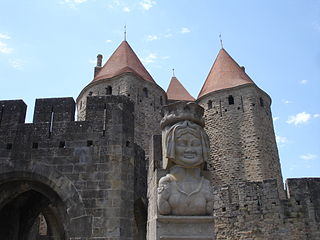
The legend
“The legend takes place in the 8th century, during the wars between Christians and Muslims in the southwest of Europe. At the time, Carcassonne was under Saracen rule and Charlemagne‘s army was at the gates to reconquer the city for the Franks. A Saracen princess named Carcas ruled the Knights of the City after the death of her husband.
The siege lasted for five years. Early in the sixth year, food and water were running out. Lady Carcas made an inventory of all remaining reserves. The villagers brought her a pig and a sack of wheat. She then had the idea to feed the wheat to the pig and then throw it from the highest tower of the city walls.
Charlemagne lifted the siege, believing that the city had enough food to the point of wasting pigs fed with wheat. The gesture lowered the morale of Charlemagne’s men who were also suffering from the long siege and a shortage of supplies.
Overjoyed by the success of her plan, Lady Carcas decided to sound all the bells in the city. One of Charlemagne’s men then exclaimed: “Carcas sonne!” (which means “Carcas rings”). Hence the name of the city.” https://en.wikipedia.org/wiki/Carcassonnehttps://en.wikipedia.org/wiki/Carcassonne
Me and Lady Carcas
I first made the acquaintance of Lady Carcas as a child. She was featured in a volume of the Childcraft books I practically lived in at the time. Her story was colorfully illustrated.
As I recall the story back then, it involved a cow, not a pig. The cow was let out through the gates of the walled city and not thrown from a tower. The waiting hordes were in flagging spirits themselves. The sight of an actual fatted calf (as it were) robbed the marauding hordes of all lust for battle and they disbanded.
Lady Carcas’ story came back to me as a struggling single parent, navigating a difficult divorce. For reasons the book I am writing will detail, I was intractably estranged and at loggerheads with the maternal side of my family. More to the point, my mother.
So as I surfed the tempestuous waves that beset me in the wake of my failed marriage, a career setback, and a teeny, tiny alcohol addiction, I played the Lady Carcas card.
I was hurting badly in the early years of my babies’ lives, emotionally and financially. But I would never let on for a second how badly to my mother or her side of the family. Sadly, this freezeout eventually included my only two siblings who were firmly planted in Mom’s corner. Me and my sisters had been intermittently close off and on growing up. But the connection after my marriage ended became easily strained and tenuous until it finally snapped.
My survival strategy in those lean and tumultuous years was to act as if I was managing all of my injuries and responsibilities without a single care. I worked. I socialized. I moved about in society as if I hadn’t a trouble in the world.
Those whose eyebrows might raise a little whilst reading about the extremity of adopting such defensive tactics within one’s own family were no doubt raised in nice, normal, supportive families. Those who were not – like I was – will recognize and relate to my experience in a heartbeat.
In a mixture of what sounded like utter frustration and despair, my mother once shrieked at me: “You don’t need anyone!” That only proved my ruse was working. If I had continued to display my pain and vulnerability in front of these flying monkeys, they would have torn me into pieces. More than they already had.
I feel a quiet debt of gratitude to Lady Carcas and her tactics of deception for a good cause. I learned much about protecting my heart and soul in the face of hostility from family rivals and about healing. The goal was to survive my family of origin long enough to emerge and stand in my own truth and certainty. It was like holding my breath underwater for a very, very long time.
When I was finally able to consistently take a full breath, then another, and yet another, it prompted me to utter a silent response of gratitude to a young French noblewoman from many centuries ago who may, or may not even, have existed.
 Expressive Compulsive