The American Buffalo

I’ve never seen a Ken Burns documentary I didn’t like. Burns’ epic two part, four hour documentary on the American Buffalo that aired last week on PBS was no exception.

I sometimes delude myself there is nothing new for me to learn. That is because I have no interest in learning astrophysics or nuclear fission. But this documentary surprised me.

It turns out there was tons I didn’t know about the history of the American Buffalo in North America. More important, I didn’t fully realize how intimately intertwined the fate of the buffalo was with the indigenous peoples who relied on them.

There used to be millions of buffalo roaming free on the open grasslands in North America back in the mid-1800s. Millions. The indigenous peoples who hunted them for food, clothing and shelter, had a deep and mystical connection with them.

Buffalo were so embedded in the life and well-being of indigenous peoples, it would have been hard for anyone to imagine they could disappear. But the American Buffalo was nearly wiped out. The tale of how the buffalo was nearly eradicated goes hand in hand with the cultural and actual genocide of many native American Indians.

Ken Burns’ documentary ostensibly starts out to teach us how the greed and violence of Europeans decimated the great North American buffalo herds. His story inevitably explores the concomitant demise of indigenous peoples who lived here first. It was shocking to see the parallels drawn so clearly.

I, like nearly every other North American kid, grew up witnessing depictions on film of the struggles between white Europeans and Native Indian tribes as a fight between good and evil. And in that order.

There was an Indian reservation quite close to a friends home in the little town I grew up in. I still remember the solemn warnings of my friends mother. “Stay away from there. The Indians are known thieves and rapists.”

Couldn’t think of a much more effective way to strike terror into the hearts and minds of two pre-pubescent girls. Even if we didn’t quite get what rape was, we knew it was very bad and we didn’t want it to happen to us.

Sadly, the buffalo didn’t have anyone to protect them. They were shot and killed in the millions by greedy white hunters. Only selected parts of the buffalo were taken as trophies or to cash in on whatever body part was in demand – their coats, or tongues, or heads. The rest of the corpses were often left on the Prairie to rot.

So we white folk – as the now predominant culture in North America – depicted the Indians as cutthroat savages who would kill us as soon as look at us. It seems ironic that white folk under similar threats – which European settlers and military battalions certainly were to them – such action was not only expected, but lauded.

History is written by the winners. If winners is the right word to describe the victors in widespread murder and land theft. It is understood that indigenous peoples did not understand the concept of private land ownership. I understand they believed themselves to be part of and stewards of the land they lived on – not owners. This lack of discernment cost native people dearly.

I watch the mealy-mouthed machinations of the predominant white culture now trying to make amends with indigenous peoples’ for the wrongs of their ancestors’ past. Canada’s truth and reconciliation commission generated an apology from the sitting government and a national day in honor of the horrific treatment of Canada’s First Nations people, especially in residential schools.

It’s something I guess. But that’s the thing about winning. The sharpest operators know it is better to beg for forgiveness, instead of asking for permission beforehand. What’s done is done, we say.

Possession is nine tenths of the law when it comes to property ownership. Conveniently, that law came into being long after the bulk of indigenous North American Indians were pushed off the lands they occupied for thousands of years. New game. New rules.

It’s little wonder indigenous peoples are working hard to reclaim what they once had and lost. They are creating a new game with their new rules.

Defragmentation

Sometimes I feel like a police scanner – to the extent I even know how a police scanner works. I scan constantly through my computer and phone throughout the day, every day. It is kind of a ritual but more of a neurosis, if I’m honest.

It is an odd combination of FOMO (fear of missing out) but also a form of hyper-vigilance. I look and constantly wait for “things that need to be tended to.” A utility bill. An enticing post or meme. A bank statement. Friends’ birthdays. All things that may need my “urgent” attention.

I am so familiar with this pattern now and the feelings it is trying to manage.

My life’s work has been trying to pull back together the fragmented pieces of myself that flew apart when I was a child and young woman. Pieces of myself flew apart on several occasions before I hit the proverbial brick wall.

When I was younger, I suffered from a bad case of arrogance of youth. I overestimated my importance and ability to change the world. It is a common arrogance that life thrashes out of most of us.

Most of us settle into familiar routines as we grow into adulthood. I see that as a gift life gives us. Even plants have to find a place to dig in and take root if they are to become fully mature and productive. It underpins the philosophy “to bloom where you are planted.”

These days, I am not so sure young people are able to access and develop those routines as easily. Young adults fret and fuss about the basics way too deeply into adulthood. Their conversations are an all too familiar commiseration about how difficult life has become. Houses are unaffordable. In longterm rental accommodation, equity cannot be built. And equity has always been the most familiar and reliable route to financial security.

So people everywhere – just like me – are enraptured by the world available to them on their rectangular anchors. Problem is – and the problem is becoming much clearer to many – the online world is illusory. It is full of bias and singular POV’s and fragments of truth.

Constantly surfing the internet is like eating and eating at a buffet and yet never feeling full. It is like watching kids play on the other side of a chainlink fence. It is like blowing kisses to loved ones on the other side of a glass wall.

Nothing can take the place of that perfect first bite of something sinfully delicious. Nothing can replace that extremely particular sensation of joy and pleasure. Nothing beats good old-fashioned hugging and giggling to bond us to each other.

So I’m devising a plan. To wean myself away from this obsessive ritual of device scanning and become more deliberate about how I spend my time. The aim is to calm my mind. To stare down the internal “to-do” list. The aim is to settle down incessant demands that are largely self-created.

For the past several months, it seems all I needed were tchotchkes from online stores which I was sure would add heaps to my sense of peace and security and wholeness. Those tchotchkes have not done that and the message is coming through loud and clear that I need to shift direction.

So I have set a path. The boundaries of that path are ill-defined at the minute but that is the process new ideas go through to get born. Less time online. More quiet time with myself and in nature.

I could wrap this up by saying something clever like, “I’m heading to the internet to find articles on exactly how to do that!” But I won’t. I’ll take my coffee outside to listen to the sounds of our community starting its day in the distance and the birds in the trees around us waking up.

There is inherently more comfort in nature than chasing illusions on the Internet. We all need to relearn that.

I’m pretty sure those birdsongs will comfort and settle me. Excuse me while I turn this off to go do that.

Fuck Fear

Fear swims into my chest unbidden and swirls around my solar plexus in aching, incessant revolutions. Dead center in my body. Unbidden and heavy … triggered by what I assume will be bad news.

It is said that while we cannot control what others do or think or what happens around us, we can control our reactions. When fear hits, I immediately think all of that is pure malarkey.

My solar plexus fills up with fear without any conscious thought on my part. It is downright creepy.

I do not invite fear to fill up inside me overwhelming my senses and my reason. But fill up inside me it does. As surely as gas goes straight into a tank when the nozzle is depressed.

Unlike pumping gas, however, the fear doesn’t stop once the nozzle is released. It feels like a more automatic process.

I have learned some remedies for managing uncomfortable feelings of fear. Intellectually, I realize the highest and best road to take in the face of fear is simply facing it.

But that is usually my strategy of last resort. I play games in my head. I avoid picking up the phone or confronting the perpetrator. I avoid whatever will connect me to the bad news I fear. My stomach churns incessantly and the fear dances and coagulates in my body’s middle region.

As a stopgap measure, avoidance is actually not so bad a choice. It gives me time to collect myself. It gives me time to steel myself for the words I emphatically do not want to hear. In the poem Desiderata, there is a line I often refer back to: “Nurture strength of spirit to shield yourself in times of sudden misfortune.”

For me, getting to that end state is unreliable. When I am already feeling run down, maybe a little vulnerable, hungry, angry, lonely or tired … the well-known HALT acronym, I tend to be even more avoidant.

I have my fair share of memories where fear and terror swooped in when my defenses were at their very lowest ebb. I had no emotional or psychological defenses as no small child does. Yet my childhood world was full of fearful happenings and sudden wrenching losses.

Dad would frequently come home drunk and beat up my mother. I could do nothing but sit on the top step of the staircase outside my bedroom and shake from a combination of fear and cold in my thin cotton nightdress. Mom told me I once put myself between the two of them and pushed them apart when they were fighting. That was a pretty ballsy move for a four year old.

My beloved golden cocker spaniel Gus and my best buddy as a toddler was killed by a car when he bolted across the road in front of our house. He had been after a quicksilver squirrel. The squirrel got away.

Noone talked to me about how Gus died. As I recall, they didn’t even actually tell me he was dead. Probably one of those incipient “white lies” parents make up, presumably to “protect” their children. Maybe at the tender age of two or three years old, they saw no need to “traumatize” me with details I could not understand. Or so they thought.

I knew something must be wrong because Gus was nowhere to be found and didn’t come to my call. I also knew when I came upon a large red pool of liquid left in the front porch after Gus’s lifeless body had been taken away.

The sadness of that loss was compounded by the secrecy and hushed voices of adults around me who talk in that sotto voce way when something terrible has happened.

I know when I make that call today, I am going to hear: “Nothing more can be done. The builder can proceed and there is no legal impediment to prevent him from doing so.” I am steeling myself for the bad news.

By contrast, yesterday, my heart filled up with joy and hope for a few hours. An investigator came from the local authorities yesterday. I was temporarily cheered and encouraged by his very presence.

In the back of my mind, however, I knew my elation and optimism was sitting on flimsy evidence. Still, hope is a powerful analgesic.

An analgesic which is about to wear off.

Fuck.

No

no

is a necessary magic

no

draws a circle around you with chalk and says

i have given enough

— boundaries

McKayla Robbins

If we are lucky we learn this early. Most don’t. Life mostly makes it impossible to learn this early. We want and need too much. There is little way of knowing early in life that we are the most important audience we are ever going to have.

In youth, we are still searching and experimenting. There is too much competition for our time and love and enthusiasm and strength. There are too many people who want to take advantage of those precious qualities. And do.

I sometimes believe there is nothing new under the sun. The trouble is we are unlikely to learn that until we have invested a great number of years and a great amount of energy in coming to that realization.

Life for the most part is an endless cycle of learning and changing. If we’re lucky. Life’s bits are doled out in manageable portions in accordance with our age and stage and ability to handle what is thrown at us and what comes up in our path. Again, if we’re lucky.

I have learned that saying “no” can be the profoundest statement of self-respect and respect for others. I once read of an author after a book reading who was offered a fan’s manuscript.

The fan wanted feedback on her writing and jumped on the chance to take advantage of the opportunity. The author politely and firmly declined: “Honey, I will never have time to read your manuscript. You’ll have to find someone else.”

That anecdote resonated with respect for me. Did she hurt the fan’s feelings? Probably. Maybe she even shocked her a little. Shocked her because the automatic knee jerk response in society from most people is to feign interest and accept such an offering without objection.

The manuscript might be heaved in the waste bin minutes later but they have greased the wheels of polite social discourse. And diminished their own integrity and self-respect in the process.

I love that story. I could only hope I could hold myself to such a high standard in a similar setting. I am sick of people who pander and strive to protect “someone else’s feelings.”

I am not suggesting we go out of our way to gratuitously hurt or insult people. But this anecdote is different. The author was asked directly to do something she did not want to do. So she said “no”.

It injected a necessary dose of reality in that aspiring-fan-cum-author. Not a pleasant experience but also not devastating. Just real. A win for everyone from where I sit.

There are no shortcuts in life really. If you circumvent the apprenticeship and required stages of trying and failing and learning from your mistakes and trying again and again until something begins working with greater frequency, you give yourself short shrift.

I sometimes think of kids born to money who make nothing of themselves or their lives because they never really had to work all that hard for anything. What comes easily is never appreciated as much as what we have fought for and worked hard for.

It has to do with investment of time, energy and love. It is the pursuit of what is inside you that really matters to you. The happiest people have listened and followed the dictates of that still, small voice within. It is still an elusive goal for most people. There is often way too much noise and distraction that drowns out the nudging of our own inner direction.

It a distressingly common tragedy.

I am getting better at “no.” I am getting better at saying “no” with love and kindness. I am getting better at recognizing what is worth pursuing and what is worth turning down. For me. The paths I do pick usually reflect some inner urging or passion or preoccupation. Those pursuits usually work out better than pursuits I have taken on half-heartedly.

So thank you for dropping by and checking in here today. Thank you for saying “yes” to what I put out there in the world. There is no expectation from any of you to do so. Just gratitude.

If it should happen one day up the road at a reading I have just given, you wish to gift me with your book length manuscript for my review and comments, remember this post. I will be honest enough to tell you (I hope) that I likely won’t read what you have written and you are best to try another tactic.

I hope I am kind and polite but firm. I hope you will recognize it is an expression of honesty and respect – both for you and for me.

Turning Point

How I love early mornings. Around 6 AM is ideal. This sacred state can usually last up until somewhere close to 8 AM.

I love the birdsong behind our house. We have a scruffy patch of untouched forest where committees of birds consort every morning to plot and plant their day. Or so it seems.

Lately, a murder of crows has taken up residence in the remaining live oaks behind us. I don’t actually know how large a group of crows has to be to be a “murder” but there is a bunch.

Straight out of birdworld central casting, they caw incessantly. Sometimes in unison and at other times, a single crow with a particularly large and booming caw rings out over the others.

The crows occasionally fly away in unison on whatever mission they have decided is necessary. I am struck by how little I know about birds as I listen to them and watch their aeronautic displays. It piques my curiosity.

I love early morning when it is quiet and the only voice I have to listen to is the voice in my own head. Uninterrupted by abrasive external distractions, I can enjoy my own sense of peace and calm.

I hear garbage trucks way off in the distance. A small aircraft buzzes by overhead. There is traffic way, way off in the distance. Soon cars will start up around me as neighbors head off to their jobs. I am no longer part of that morning migration and I am so grateful that is so.

Yesterday, I wrote what was for me a fairly disturbing post about an art installation replicating our collective Sisyphean task of chasing money to sustain our lives with increasingly diminishing returns until we die. I used to be acutely aware that there was an inherently unbalanced tradeoff between time and money in my life and that of others.

When I had enough free time to pursue personal interests, I rarely had enough money to freely do so. When I was employed and earning money, the time I needed to pursue personal interests was eliminated. A devil’s bargain.

I am at a stage where I am resetting my goals. I am no longer convinced I will write the Great North American novel or bank countless millions with which to address the world’s ills. In truth, I never really had those goals but, at least when I was younger, they seemed attainable. Of course, almost everything seems possible when you are young.

I have come to one simple conclusion for my future direction. My life, my rules. I fervently pray (and hopefully believe) I will never have to work at a boring and unfulfilling job again. I grieve for the people that do. I grieve that I had to for so long.

I will no longer “dress to impress” anonymous others whom I hope may look kindly upon me and bestow some favor or another – financial or emotional.

I will no longer be silent or cagey in the face of outrageous circumstances. Strategic maybe, but not cagey. Life has taught me the truth of that you can attract more flies with honey than vinegar … if it is flies that you are out to attract, of course. And for the life of me, I can’t imagine why one would.

This is a time of transition in my life unlike so many other transitions that preceded it. Life used to feel like having a bolt of fabric from which you could endlessly pick patterns and play with design and create costumes ad infinitum. Now I know the bolt of cloth I was handed is not infinite. Going forward, I must pick and choose the patterns and designs much more carefully and wisely.

Even these thoughts about my future are just forming. So much that used to drive my ambition and thinking has ebbed away. I am not as angry or tortured as I once was. I am wiser. I have made immutable choices in career, children and partner which have created a clearly boundaried paddock within which I will live out the rest of my life. Best make it the best it can be for me and my loved ones.

Dangers abound on the road ahead [like they always did] but so does adventure. And learning. And friendship. Blessed friendship. There are so many people without whom I would not be here today.

It is the harvest time in my life. To reflect on where I’ve been more deeply than where I’m going. To appreciate what went right and forgive myself and others for what went wrong. And for the most part, most of it no longer matters.

In a hundred years, it will matter to no one, except in one way. The external dragons and internal demons I’ve slayed will be a lesser threat to my children and theirs and the children of my great grandchildren ad inifinitum. I hope.

Knowing this in my bones has, if for no other reason, made all of the struggle worthwhile.

Read and Weep

This is not my photo down below. These are not my words.

This is a piece about an art installation. An installation that deeply affected writer James Kricked Parr. Had I seen it in person, I imagine I would have felt the same. I imagine I would have written about it in the same way. Grief stricken.

The truth of this upsets me. To read a more detailed background of how this art installation came about, check https://www.truthorfiction.com/cant-help-myself-robot-arm/

I agree with Parr that the concept and how the artists manifested it is deeply affecting. Truth can be a troubling mirror. The piece ends on a relative high note. It urges us to take good care of ourselves. To rest and heal regularly. Even while living inside this system that most of us are trapped in. None of us are getting out of it alive.

“No piece of art has ever emotionally affected me the way this robot arm piece has. It’s programmed to try to contain the hydraulic fluid that’s constantly leaking out and required to keep itself running…

If too much escapes, it will die so it’s desperately trying to pull it back to continue to fight for another day. Saddest part is they gave the robot the ability to do these ‘happy dances’ for spectators.

When the project was first launched the robot danced around spending most of its time interacting with the crowd since it could quickly pull back the small spillage. Many years later… it looks tired and hopeless as there isn’t enough time to dance anymore.

It now only has enough time to try to keep itself alive as the amount of leaked hydraulic fluid became unmanageable as the spill grew over time. Living its last days in a never-ending cycle between sustaining life and simultaneously bleeding out. (Figuratively and literally as its hydraulic fluid was purposefully made to look like it is actual blood).

“The robot arm finally ran out of hydraulic fluid in 2019, slowly came to a halt and died – and I am now tearing up over a friggin’ robot arm 😭 It was programmed to live out this fate and no matter what it did or how hard it tried, there was no escaping it. Spectators watched as it slowly bled out until the day that it ceased to move forever.
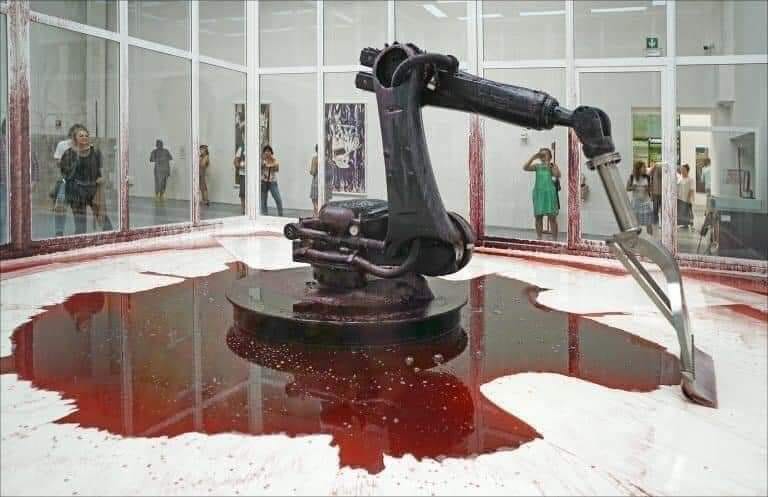
Saying that ‘this resonates’ doesn’t even do it justice. Created by Sun Yuan & Peng Yu, they named the piece, ‘Can’t Help Myself’. What a masterpiece. What a message.”

Parr’s extended interpretation: the hydraulic fluid [represents] how we kill ourselves both mentally and physically for money just in an attempt to sustain life,

How the system is set up for us to fail on purpose to essentially enslave us and to steal the best years of our lives to play the game that the richest people of the world have designed.

How this robs us of our happiness, passion and our inner peace.

How we are slowly drowning with more responsibilities, with more expected of us, less rewarding pay-offs and less free time to enjoy ourselves with as the years go by.

How there’s really no escaping the system and that we were destined at birth to follow a pretty specific path that was already laid out before us.

How we can give and give and give and how easily we can be forgotten after we’ve gone.

How we are loved and respected when we are valuable, then one day we aren’t any longer and we become a burden…and how our young, free-caring spirit gets stolen from us as we get churned out of the broken system that we are trapped inside of.

Can also be seen to represent the human life cycle and the fact that none of us make it out of this world alive.

But also can act as a reminder to allow yourself to heal, rest and love with all of your heart. That the endless chase for ‘more’ isn’t necessary in finding your own inner happiness.”

– James Kricked Parr

May be an image of 4 people

Dad’s 110th

Had he lived, my father would be 110 years old today. He didn’t have much of a life. Not what you’d call a “good life.” Not from my point of view anyway.

But Dad was survivor. I inherited that from him. From both parents, if I’m honest.

Dad was a severely abused child. Physically and emotionally. The worst tormenter in his young life was his mother. By all accounts, she was a selfish and heartless woman. She was known to be unsatisfied with her lot in life. I doubt that is the reason why she abused her children. If she were alive today, I am sure she would be diagnosed with some degree of sociopathy.

Dad blamed his mother for most of his emotional ills and difficult, fragmented life path. Dad also blamed his father because he didn’t step up to intervene in her assaults.

Possibly the worst story I heard was that of the kerosene barrel. Back in the days of the early twentieth century, kerosene was a necessary household staple. It kept kerosene lamps alight. It fueled kerosene heaters for necessary warmth in the piercing mid-winter cold of provincial East Coast Canada.

Dad was a curious child. A trait he carried forward into late adulthood. His interests seemed boundless. That curiosity led him to the woodshed one evening where the kerosene barrel was kept. Ominously, he had brought a box of matches with him.

When he lit a match, the uncovered kerosene barrel flared up and burned all of my father’s face. At the tender age of only 7 or 8 years old, my father would have been nose-to-nose with the barrel. He screamed piteously and his mother came running out of the house from the kitchen, just inside.

In rapid succession, she saw the kerosene barrel after the flareup extinguished itself, the matches and my father. In a rage, she slapped her hand across my father’s red and peeling face. The details of what happened after are mostly left to speculation.

Dad recalled that the skin of his face hung down on the sides. The damage was so extensive, he was never able to grow a beard. Hearing the story later as a young adult, I was horrified and stupefied.

A normal mother and normal parents might have bundled up their injured child and rushed him to a hospital. That did not happen. In the classic response of an abused child, my father exonerated my grandmother: “She stayed up all night putting egg whites on my face.”

It took years of healing myself to understand the enigma that my father was. He was a handsome, well-built, strapping man. Yet until the day he died on December 24, 2005, a large part of him remained that fearful and abused child.

Dad described himself as suffering from an “inferiority complex.” I would describe it now as post-traumatic stress disorder. He never really recovered.

Bear in mind this horror story is only the tip of an emotionally abusive iceberg. I can only imagine the small and consistent episodes of abuse and general lack of love in that household that my father and his two older brothers endured.

I admired Dad because he never stopped searching for a cure to his inner anguish and turmoil. He took several Dale Carnegie courses. Carnegie’s “How to Win Friends and Influence People” had a prominent place on the bookshelf beside Dad’s law books. Dad won awards for public speaking at these meetings.

He attended “Men’s Retreats” put on – I assume – by some church group. Catholic, no doubt, as that was the predominant religion and power broker in the province of Newfoundland at the time.

Dad tried and repeatedly failed to quit booze for good. He got all the way up to one year of sobriety once. But on his 92nd birthday – just two months before his death – he was drunk as a lord and emotionally effusive as he would always be when loaded. I had begun to not care. His deficits created many of my own and I was in the middle of sorting through them and trying to heal.

It would be fair to say my Dad was an atypical father. He didn’t seem to have the protective instincts of other fathers I encountered among my friendship group. Support from him was erratic and situation specific. He was feeling good about life and himself, I was often the beneficiary. When I really needed something and asked for it, I would be denied if he didn’t feel generous.

Dad knew he was afflicted. He used to say: “I am doing my inadequate best.” High marks for self-awareness.

Of course, Dad would not have lived to 110. I am not sure I would have wished him to. HIs passing for me was tinged with equal measures of grief and relief. He left an emotional morass and three badly damaged daughters in his wake.

I don’t know if I will be be able to leave a cleaner slate when I die. I certainly followed in his footsteps in many ways. The difference is that I was able to seek and find relief and healing from my abuse. To be fair, I grew into a time where that was more acceptable and easier to access in society.

Still today, in particular, I think of him and the influence he had on me and my life. I’d like to tell him I survived him. I might phrase that differently if I were face-to-face with him. He was my Dad and I loved him. I would say he loved me and my sisters in his way.

I would also say, that just like him, in the realms of parenting and marriage, I am doing my inadequate best. I have worked my whole life to break the ties of intergenerational trauma. I hope my children and grandchildren will eventually benefit from that. Time will tell.

RIP Dad. I hardly knew you but I send my love to you today. Wherever you are.

Shot Down

I wish I was spiritually evolved enough to roll with life’s punches and “see the lesson” in them as they hit. I am not. I ruminate more than I should over woundings and insults whether they are hurled intentionally or not.

The house build behind us is moving forward. I did everything I could to intervene and stop it. I stalled it by a month but my overall attempt has failed. The house markers have been set in the ground. A white pickup truck with an engineering logo on its side doors regularly visits the property no doubt finalizing the build strategy. The Wildlife Commission wrote an email this week to say there is no gopher tortoise violation on the “subject property” as I had hoped.

The die – as they say – appear to have been cast.

Part of me thinks this is instant karma. Punishment from the Universe for cutting a real estate agent we’d been working with – no binding contract but more of an implicit arrangement – out of the closing. We had to move fast and efficiently to get the house, I reckoned. Part of me knows I am rationalizing.

Fear-based thinking. Again.

There was a something that lingered in the air above this house deal though. Something I couldn’t quite put my finger on. That may sound a little too flakey for most of you. It is too flakey and “oooie, oooie” for me to take seriously. But I wonder.

I think of all the ways in which this development could be worse. I think of the chaos and upheaval of Israelis and Palestinians preparing for the savagery of war. I reflect on seeing an arm uncovered in the rubble of that Gaza hospital and the horrible news that will be delivered to a family. Many families in this case. I think about Ukrainians returning to where their family homes once stood and learn they have been obliterated by bombs.

My troubles are so small by comparison. Miniscule. But they are my troubles. I feel I need to stand up for them and give them their emotional due. I spent years ignoring and diminishing hurtful events in my life. They just backed up inside of me.

I would explode disproportionately when some other minor insult triggered the backed up, unhealed hurt inside of me. The earlier hurt hadn’t been dealt with so it could dissipate. It had merely gone underground waiting to rear its ugly head when triggered – usually by a more minor threat by a relatively innocent bystander.

It is common for people to ignore or diminish troubles of others when those troubles don’t affect them personally. There is a human tendency to feel a sense of sympathy and concern about others’ misfortunes and an equal measure of relief because it isn’t happening to them.

We all encounter problems on our journey in life. Mostly we are thankful when someone else’s tragedy does not touch our own life. When tragedy does strike us, we pray for the grace and strength to face and overcome it. It is one of life’s toughest learnings.

People are not comfortable generally with strong feelings. Either their own or someone else’s. We like our shared illusion of a calm and stable society.

If strong feelings were easily accepted and as easily processed, the booze and illicit drug business would collapse. Angry people are called “hysterical” unless the listener has buy-in with the issue people are angry about. I think of Trump and his legions of followers who eagerly slurp up his incessant brand of outrage over hard done by “patriots” like him.

It is so automatic to shush a child who is crying healing tears. It is common to accuse a woman of “being dramatic” when a sudden, inconceivable loss bends her in half convulsed in tears. Or her husband has beaten her senseless and is holding her children hostage in a bitter custody case.

Unbelievably, Alex Jones accused grieving Sandy Hook parents of delusion when their children were mowed down by a madman toting an AR-15. Jones finally came to justice but not before numerous grieving parents were tortured and belittled by Jones’ ardent followers.

The insinuation of grief creeps slowly into our lives. It is easier to manage when we are young, we reason, because we are more resilient. We can certainly move on faster. When we’re older, the processing of grief is usually more internal. “Stiff, upper lip” syndrome comes into play.

Loss is a fact of life. Some losses we can easily identify and readily relate to. Other losses are more personal and nuanced. How we learn to handle loss is spread across a very wide continuum.

So I accept that I am on a grieving path. For trees. And a view. And a dream of peace and solitude that will soon be irrevocably shattered. Does it matter in the grand scheme of things? Of course not. But does it matter to me? Absolutely.

I have learned that self-love and self-respect means owning all of our feelings and failings and giving them their due until they have been integrated into your heart and psyche. Life is not an endless series of “happy, happy, happy.” I challenge anyone to show me someone whose life is.

Change is inevitable and pain is manageable. I take this recent loss as another opportunity to apply what I’ve learned about managing disappointment. And of course, I wish I didn’t have to. I’m only human, after all.

How America Got Mean

From The Atlantic, August 14, 2023.

A culture invested in shaping character helped make people resilient by giving them ideals to cling to when times got hard. In some ways, the old approach to moral formation was, at least theoretically, egalitarian: If your status in the community was based on character and reputation, then a farmer could earn dignity as readily as a banker. This ethos came down hard on self-centeredness and narcissistic display. It offered practical guidance on how to be a good neighbor, a good friend.”

How America Got Mean. Written by David Brooks, someone who is quickly becoming my favorite writer.

This article needs to be shared – and read – widely.

https://www.theatlantic.com/magazine/archive/2023/09/us-culture-moral-education-formation/674765/?utm_source=copy-link&utm_medium=social&utm_campaign=share

Looking Up

I sure needed these little nuggets of joy I found recently.

In one astonishing clip, a four year old boy speaks to his mom about his emotions and how he is processing them. Four years old!! I know forty year olds (and even much older) who couldn’t get close to this level of emotional clarity. https://www.facebook.com/reel/562156025745695

Another story highlighted the business venture of a young French architect Clarisse Merlet who is making construction materials out of recycled fabrics. Bricks to be exact. https://www.euronews.com/culture/2023/09/04/meet-the-french-eco-chic-architect-crafting-fashionable-bricks

Hers is a small, energy intense, hands-on little business. To date, she has already made 12,000 clothing bricks. She has sold them as office partitions and decorative items. She is doing a lot of research to expand their utility and reach in large scale construction projects.

The concept could not be simpler and yet more profound in its potential impact. Who among us doesn’t have a few dozen pieces of extra clothing in our closet that we could easily offload? Having them reused sustainably would be a total bonus.

Kermit The Frog popped up somewhere singing a Talking Heads cover: “Once in a Lifetime.” https://youtu.be/PCY0aeUx-Ns

YouTube gold. Kermie captured my heart years ago with, “It’s Not Easy Being Green”, a sentiment we can all relate to the way Kermie sings it. And, of course, The Rainbow Connection. That musical gem still gives me goosebumps.

A writer in the New Yorker pens a comic strip about an elderly gentleman who plays the sound of birds chirping in his car all the time. It is his way of feeling like he is in the country when he is still living in the city.

More and more often, I am reading rebellious writers like me who are pushing back against the execrable weight of information overload and faceless wealth hoarding billionaires. Like me, too, it seems, they are trying to tease out and claw their way back to a sense of what it means to be human. Especially these days.

They give me hope for today and for the future. Maybe this dog’s breakfast we are living through will have a satisfactory ending after all.

And to drift into political waters that I usually avoid like the plague, Jim Jordan wasn’t elected House speaker. It looks very much like he won’t be.

That single news story tells me there may be hope and common sense at work out there in the world, after all. Sigh.