Even Keel

I would love to feel every day exactly as I do this morning. Calm. Grounded. Mostly untroubled (though I could probably stir things up pretty quickly by glancing at my “to-do” list! So I won’t.)

I am nearing the end of my grieving process for the lost forest behind us. I recognize I have gone through the five stages of grieving made famous by Swiss psychiatrist, Elisabeth Kubler-Ross.

In 1969, Elisabeth Kübler-Ross described five common stages of grief, popularly referred to as DABDA. They include:

  • Denial
  • Anger
  • Bargaining
  • Depression
  • Acceptance

I have gone through nearly all of them. I am transitioning from depression to acceptance. What is happening on that back lot is not within my control. It never was.

I did give the legal route a try and contacted the county powers-that-be and came up with bupkis. Apparently, disrupting a neighbor’s dream and destroying their privacy is not sufficient for a “stop build” order.

So I’ve learned things about grief and the process it wends its way through. Not for the first time.

I’m not sure anyone can adequately prepare themselves for grief. It is one of those things that reads much differently on the page than it feels in real life.

None of us can prepare for the shredding of our reality by the departure of someone or something that matters deeply to us. Whether that is a person, or a pet, or the availability of something or a dream. And yet, we all have – or most certainly will – experience loss.

I have a regular habit I employ now when I expect bad news. I erect a psychological barrier. Bad news coming by mail: don’t open it. Bad news coming by phone: don’t answer it. Bad news at your front door: don’t answer that either.

Not indefinitely, but for as long as it takes to shore up my inner resources and prepare. We are often given the gift of time to prepare with an impending death. It does not necessarily make the actual loss easier. But pre-grieving is a real thing that allows us to imagine what life will be when she/him/it/they are not longer present.

I did it with both of my parents.

Their age and infirmities set me up to begin grieving them long before they left. It did not change how I was with them in the day-to-day. It built an emotional cushion inside me and made space for the inevitable loss. In both deaths, there was grieving but also relief and resolution. In sudden or premature death, that is not always possible.

Processing grief is critical if we are to move on in life. I have a friend who lost her young adult daughter suddenly and violently in a car crash. More than twenty years later, that loss is still the core of her emotional life. It has driven her to an alcoholism and a gambling addiction. She is neither fully engaged nor present in her everyday life.

Leaving the emotional safety of grief can be a terrifying leap of faith. It is a common, if ineffective, way to keep someone’s presence in your life even when they are emphatically gone. When grief has not been processed and integrated, it can screw us up and stunt our growth and healing.

My friend has found comfort and escape in booze and gambling. Not the most healthy response. Her behavior hurts not only her but those around her. Yet there is nothing anyone can do unless she elects to do something differently. That is the responsibility of being an adult.

These past few weeks (months maybe) have been exceedingly difficult. Not only because of the lost forest but other losses and realizations. Though our house move was mostly positive, it has been incredibly taxing. I have learned I am not as strong and energetic as I once was. I am more and more aware of our limited time on the planet.

I have been advised to learn to let go. I once described my self as someone who clung to the mast on a boat (my life) that was shipwrecked and taking on water fast. That worked for a long time though I know how much I missed with my inflexibility and neuroses. No matter. I survived.

I am going in a different direction now and making different choices. And this morning’s mood was an unexpected payoff. Peace actually is possible even in the face of disappointment and loss. Even if it takes awhile to get there.

Damned if I am going to spit in god’s face for the gifts and good things I have in my life by letting loss overwhelm me. God will deal with the perpetrators in time and in his/her own way. Or not.

Perchance to Dream

It is rather brilliant how we keep the harsher realities of life at arm’s-length as we go about our day-to-day lives.

Death occurs around us all the time. It is happening somewhere right now to someone we don’t even remotely know and now never will. We rarely feel death’s bite until it is up close and personal. When someone in our family dies, or in our circle, however, the hole left in our own little world is palpable and vast.

Whether suddenly or after a long illness, the transition from interacting with a thinking, breathing individual to internalizing their utter absence is wrenching. It can stir up all manner of emotional reactions and invite you into a period of self-reflection. If you’re lucky.

Starting out in life, mostly we are lucky enough to ignore all of that. As young people struggling to find their feet and make their own lives, the primary focus in early adulthood is on building an education and career and home and family. Not for everybody, especially these days, but for many.

In his book, The Myth of Normal, author, physician and public speaker Gabor Mate challenges the collective concept of “normalcy.” He challenges our notions of what currently passes as “normal” in our physical and psychological lives in the Western world.

Instead, Mate says, our culture and the institutions it has created, are founded on very unhealthy and unstable ground. We have built most of our health and support systems focused on intervention and not on prevention.

In this sense, our society has built responses based largely on reactive and superficial markers. Doctors rarely have time to dig deep enough into a person’s history and social/emotional context to gather information about conditions that might underly and caused their illness.

Mate asserts that personal and cultural trauma contributes significantly to all health problems – both physical and psychological — and the physical and psychological cannot be fully separated from one another.

I could not agree more. It is life’s inequalities and access to opportunities that shape us. Also – as Mate explains – we are all defined for better or worse by the circumstances of our birth and the family we are born into. The continuum is widely divergent.

We paint over the divergence from our personal experience of “normalcy” with stories or rationalizations. Our co-created narrative attempts to explain away why our “normal” family is somehow legitimately different or unique or better than or less than others.

In our family, my mother dictated the value of accomplishment above almost everything. My father saw value in great wealth. While these were their espoused values, their reality was markedly different.

Ongoing struggles in both parents with addiction and self-esteem. Inter-personal violence. Destructive power struggles between my mother and father as they sought to prove superiority over the other.

So we had a house. And cars. And my parent’s had careers. And a marriage. And social standing. Until, one day, suddenly, they didn’t.

It is hard to grieve the death of a way of life. I look back now on how radically and permanently my life changed when my parents split up and we left the town I was born in. It would be rare for a child to make sense of what was happening to them in a traumatic environment at the moment. Children’s primary job is to survive and grow. Making sense of how they did that must come later.

I think of this when I reflect on the Ukraine or Gaza. The reality they are living through – the children in particular – will become their memory of ”normal” up the road. Yet we all seem to proceed with the expectation that to succeed in life, the survivors must simply put the past behind them, step up to do what must be done to make a life and integrate themselves as productive and “normal” citizens.

We do ourselves no favors by ignoring death’s reality and eventuality around us and for us. Traditional farmers seemed to have a better handle on this than city folk. The cycles of birth and death can be daily occurrences in lives lived close to the land.

Collectively, we are all “whistling past the graveyard.” So the trick is not necessarily to focus on death and its certainty while we are living our lives. But we shouldn’t discount it either.

Poet Mary Oliver dealt with an abusive childhood background by turning her focus to nature and exploring her own sense of wonder. It is available to all of us if we but look. We all need to figure out what Oliver famously asked of us: “Tell me, what is it you plan to do with your one wild and precious life?” 

Answering that question for yourself and living it out is the rebuttal you will draw on when facing your own death. It will also allow you to create your own personal and unique sense of “normalcy,” and not one imposed on you by others.

It’s in you, believe me. All you have to do is find the courage and character to act on it. That is what I tell myself anyway and, for the most part, it is working.

Thank You In Advance

What ever would the world do without war? How ever would it have evolved without brave men and women who donned uniforms and weapons when called upon and did their bit “for the side”?

The two latest world wars seemed to have a clear sense of purpose. In my Dad’s eyes, the goal of World War Two was simple: “Defeat Hitler.”

Our debt to veterans is honored on one day each year on this continent. Remembrance Day, it is called, in Canada. Veteran’s Day in the US. There may be similar occasions honoring the fallen in other countries but my research has not advanced that far.

Those who fought for our freedom paved the way for us to continue a way of life. That can be argued ad infinitum but is simply out of place on Remembrance Day on Saturday this year.

I was always struck by how deeply Remembrance Day services affected me. There is something profoundly moving and tender about watching declining old men and women rise shakily from their lawn chairs.

They gain their footing and toss off their lap quilts to salute their flag. Of course, we see broken old people and cannot see the strong, youthful soldiers they remember in their minds’ eye.

War is easy to forget and discount if you aren’t touched by it personally. For my parents, it was a huge and affecting chunk of their adulthood that solidified their pride in and allegiance to their country. It gave them a common purpose and a common cause.

Hitler made an easy, if evasive, target. He was so unarguably evil and psychotic. He surrounded himself with similarly sick souls who shared his inhumanity. Sadly, the harsh truth is that bullying and intimidation are effective short-term tools for pulling and keeping people in line. RIP six million Jews. Hitler’s brownshirts were merely thugs and criminals and they were good at it.

It baffles me how widespread and entrenched the banality of evil can be. Most local Germans living close to concentration camps refuted any knowledge of what had “really been going on”. Perhaps the worst is, had they known, what would or could they have done?

It was heartening in the wake of World War Two to see many international cooperation organizations emerge. Devoted to achieving and maintaining – if not global world peace exactly – then overarching institutions dedicated to wide scale cooperation and information sharing.

The United Nations. United Nations High Commissioner for Refugees. The Food and Agriculture Organization. UNESCO (United Nations Educational, Scientific and Cultural Organization). The World Health Organization. The World Bank. And more than a dozen others.

Spotty and underwhelming as the overall record of United Nations organizations may be, it serves the world to have them in place. Yes, they are big, gangly organizations that don’t have a great track record at fulfilling their mandates or promises of defusing conflict or stopping wars. But I would argue, it is better we have them than not.

The world when the last World Wars took place is not remotely the same world as it is today. Young people today have little to no connection to the costs of war or what exactly the evil was that our ancestors fought.

It is good to have international organizations who ostensibly have an eye on the “big picture” as concerns the world. It is also good that our present military and government sets aside a day a year to thank our veterans.

It serves to remind us who were not there of what others lost and gained for our benefit. Their sacrifice was not only of time. Their youth, and youthful ideals, rarely came home from the front intact.

So I will plant myself somewhere quiet on the eleventh day of the eleventh month at the eleventh hour. I will happily spend two minutes to remember those who went before to fight for our freedom and protect us from living in oppression.

I don’t mean to sound like Pollyanna. I don’t much like war either. And, of course, I wish there were better ways to resolve conflict. But November 11th isn’t really about any of that.

It is a collective expression of honor and respect for those gutsy men and women who joined up to join forces against evil when they were most needed. What they left behind is not perfect by a long shot. But they did accomplish this.

Theoretically, we can follow our own inner dictates to build the lives we want. Imperfect, I realize. But when we celebrate our collective victory over the failure of that twisted little Austrian, I know my thanks are abundant. Simply because we don’t have to live in a regime according to the dictates of him and his fellow henchmen.

For that reason alone, I happily say thank you day after day after day to my many ancestors who served, and I will say a special thank you, especially this coming Saturday.

RIP Dad RIP Scott RIP Monty RIP Joyce RIP Frank, et. al.

The American Buffalo

I’ve never seen a Ken Burns documentary I didn’t like. Burns’ epic two part, four hour documentary on the American Buffalo that aired last week on PBS was no exception.

I sometimes delude myself there is nothing new for me to learn. That is because I have no interest in learning astrophysics or nuclear fission. But this documentary surprised me.

It turns out there was tons I didn’t know about the history of the American Buffalo in North America. More important, I didn’t fully realize how intimately intertwined the fate of the buffalo was with the indigenous peoples who relied on them.

There used to be millions of buffalo roaming free on the open grasslands in North America back in the mid-1800s. Millions. The indigenous peoples who hunted them for food, clothing and shelter, had a deep and mystical connection with them.

Buffalo were so embedded in the life and well-being of indigenous peoples, it would have been hard for anyone to imagine they could disappear. But the American Buffalo was nearly wiped out. The tale of how the buffalo was nearly eradicated goes hand in hand with the cultural and actual genocide of many native American Indians.

Ken Burns’ documentary ostensibly starts out to teach us how the greed and violence of Europeans decimated the great North American buffalo herds. His story inevitably explores the concomitant demise of indigenous peoples who lived here first. It was shocking to see the parallels drawn so clearly.

I, like nearly every other North American kid, grew up witnessing depictions on film of the struggles between white Europeans and Native Indian tribes as a fight between good and evil. And in that order.

There was an Indian reservation quite close to a friends home in the little town I grew up in. I still remember the solemn warnings of my friends mother. “Stay away from there. The Indians are known thieves and rapists.”

Couldn’t think of a much more effective way to strike terror into the hearts and minds of two pre-pubescent girls. Even if we didn’t quite get what rape was, we knew it was very bad and we didn’t want it to happen to us.

Sadly, the buffalo didn’t have anyone to protect them. They were shot and killed in the millions by greedy white hunters. Only selected parts of the buffalo were taken as trophies or to cash in on whatever body part was in demand – their coats, or tongues, or heads. The rest of the corpses were often left on the Prairie to rot.

So we white folk – as the now predominant culture in North America – depicted the Indians as cutthroat savages who would kill us as soon as look at us. It seems ironic that white folk under similar threats – which European settlers and military battalions certainly were to them – such action was not only expected, but lauded.

History is written by the winners. If winners is the right word to describe the victors in widespread murder and land theft. It is understood that indigenous peoples did not understand the concept of private land ownership. I understand they believed themselves to be part of and stewards of the land they lived on – not owners. This lack of discernment cost native people dearly.

I watch the mealy-mouthed machinations of the predominant white culture now trying to make amends with indigenous peoples’ for the wrongs of their ancestors’ past. Canada’s truth and reconciliation commission generated an apology from the sitting government and a national day in honor of the horrific treatment of Canada’s First Nations people, especially in residential schools.

It’s something I guess. But that’s the thing about winning. The sharpest operators know it is better to beg for forgiveness, instead of asking for permission beforehand. What’s done is done, we say.

Possession is nine tenths of the law when it comes to property ownership. Conveniently, that law came into being long after the bulk of indigenous North American Indians were pushed off the lands they occupied for thousands of years. New game. New rules.

It’s little wonder indigenous peoples are working hard to reclaim what they once had and lost. They are creating a new game with their new rules.

Fuck Fear

Fear swims into my chest unbidden and swirls around my solar plexus in aching, incessant revolutions. Dead center in my body. Unbidden and heavy … triggered by what I assume will be bad news.

It is said that while we cannot control what others do or think or what happens around us, we can control our reactions. When fear hits, I immediately think all of that is pure malarkey.

My solar plexus fills up with fear without any conscious thought on my part. It is downright creepy.

I do not invite fear to fill up inside me overwhelming my senses and my reason. But fill up inside me it does. As surely as gas goes straight into a tank when the nozzle is depressed.

Unlike pumping gas, however, the fear doesn’t stop once the nozzle is released. It feels like a more automatic process.

I have learned some remedies for managing uncomfortable feelings of fear. Intellectually, I realize the highest and best road to take in the face of fear is simply facing it.

But that is usually my strategy of last resort. I play games in my head. I avoid picking up the phone or confronting the perpetrator. I avoid whatever will connect me to the bad news I fear. My stomach churns incessantly and the fear dances and coagulates in my body’s middle region.

As a stopgap measure, avoidance is actually not so bad a choice. It gives me time to collect myself. It gives me time to steel myself for the words I emphatically do not want to hear. In the poem Desiderata, there is a line I often refer back to: “Nurture strength of spirit to shield yourself in times of sudden misfortune.”

For me, getting to that end state is unreliable. When I am already feeling run down, maybe a little vulnerable, hungry, angry, lonely or tired … the well-known HALT acronym, I tend to be even more avoidant.

I have my fair share of memories where fear and terror swooped in when my defenses were at their very lowest ebb. I had no emotional or psychological defenses as no small child does. Yet my childhood world was full of fearful happenings and sudden wrenching losses.

Dad would frequently come home drunk and beat up my mother. I could do nothing but sit on the top step of the staircase outside my bedroom and shake from a combination of fear and cold in my thin cotton nightdress. Mom told me I once put myself between the two of them and pushed them apart when they were fighting. That was a pretty ballsy move for a four year old.

My beloved golden cocker spaniel Gus and my best buddy as a toddler was killed by a car when he bolted across the road in front of our house. He had been after a quicksilver squirrel. The squirrel got away.

Noone talked to me about how Gus died. As I recall, they didn’t even actually tell me he was dead. Probably one of those incipient “white lies” parents make up, presumably to “protect” their children. Maybe at the tender age of two or three years old, they saw no need to “traumatize” me with details I could not understand. Or so they thought.

I knew something must be wrong because Gus was nowhere to be found and didn’t come to my call. I also knew when I came upon a large red pool of liquid left in the front porch after Gus’s lifeless body had been taken away.

The sadness of that loss was compounded by the secrecy and hushed voices of adults around me who talk in that sotto voce way when something terrible has happened.

I know when I make that call today, I am going to hear: “Nothing more can be done. The builder can proceed and there is no legal impediment to prevent him from doing so.” I am steeling myself for the bad news.

By contrast, yesterday, my heart filled up with joy and hope for a few hours. An investigator came from the local authorities yesterday. I was temporarily cheered and encouraged by his very presence.

In the back of my mind, however, I knew my elation and optimism was sitting on flimsy evidence. Still, hope is a powerful analgesic.

An analgesic which is about to wear off.

Fuck.

Read and Weep

This is not my photo down below. These are not my words.

This is a piece about an art installation. An installation that deeply affected writer James Kricked Parr. Had I seen it in person, I imagine I would have felt the same. I imagine I would have written about it in the same way. Grief stricken.

The truth of this upsets me. To read a more detailed background of how this art installation came about, check https://www.truthorfiction.com/cant-help-myself-robot-arm/

I agree with Parr that the concept and how the artists manifested it is deeply affecting. Truth can be a troubling mirror. The piece ends on a relative high note. It urges us to take good care of ourselves. To rest and heal regularly. Even while living inside this system that most of us are trapped in. None of us are getting out of it alive.

“No piece of art has ever emotionally affected me the way this robot arm piece has. It’s programmed to try to contain the hydraulic fluid that’s constantly leaking out and required to keep itself running…

If too much escapes, it will die so it’s desperately trying to pull it back to continue to fight for another day. Saddest part is they gave the robot the ability to do these ‘happy dances’ for spectators.

When the project was first launched the robot danced around spending most of its time interacting with the crowd since it could quickly pull back the small spillage. Many years later… it looks tired and hopeless as there isn’t enough time to dance anymore.

It now only has enough time to try to keep itself alive as the amount of leaked hydraulic fluid became unmanageable as the spill grew over time. Living its last days in a never-ending cycle between sustaining life and simultaneously bleeding out. (Figuratively and literally as its hydraulic fluid was purposefully made to look like it is actual blood).

“The robot arm finally ran out of hydraulic fluid in 2019, slowly came to a halt and died – and I am now tearing up over a friggin’ robot arm 😭 It was programmed to live out this fate and no matter what it did or how hard it tried, there was no escaping it. Spectators watched as it slowly bled out until the day that it ceased to move forever.
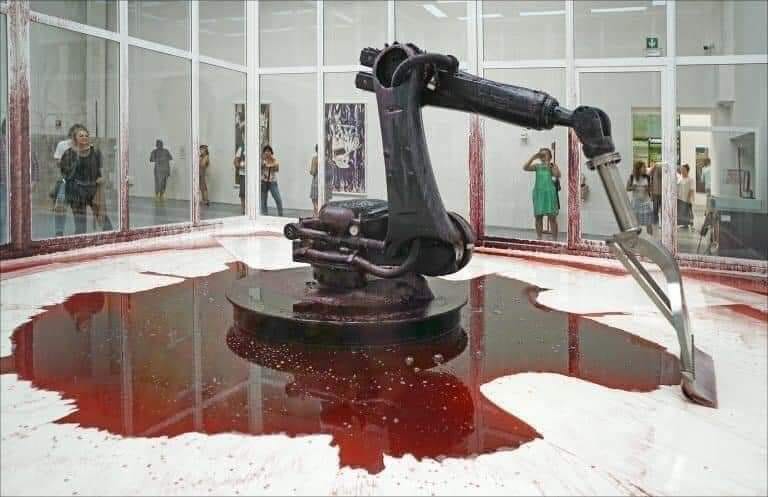
Saying that ‘this resonates’ doesn’t even do it justice. Created by Sun Yuan & Peng Yu, they named the piece, ‘Can’t Help Myself’. What a masterpiece. What a message.”

Parr’s extended interpretation: the hydraulic fluid [represents] how we kill ourselves both mentally and physically for money just in an attempt to sustain life,

How the system is set up for us to fail on purpose to essentially enslave us and to steal the best years of our lives to play the game that the richest people of the world have designed.

How this robs us of our happiness, passion and our inner peace.

How we are slowly drowning with more responsibilities, with more expected of us, less rewarding pay-offs and less free time to enjoy ourselves with as the years go by.

How there’s really no escaping the system and that we were destined at birth to follow a pretty specific path that was already laid out before us.

How we can give and give and give and how easily we can be forgotten after we’ve gone.

How we are loved and respected when we are valuable, then one day we aren’t any longer and we become a burden…and how our young, free-caring spirit gets stolen from us as we get churned out of the broken system that we are trapped inside of.

Can also be seen to represent the human life cycle and the fact that none of us make it out of this world alive.

But also can act as a reminder to allow yourself to heal, rest and love with all of your heart. That the endless chase for ‘more’ isn’t necessary in finding your own inner happiness.”

– James Kricked Parr

May be an image of 4 people

Dad’s 110th

Had he lived, my father would be 110 years old today. He didn’t have much of a life. Not what you’d call a “good life.” Not from my point of view anyway.

But Dad was survivor. I inherited that from him. From both parents, if I’m honest.

Dad was a severely abused child. Physically and emotionally. The worst tormenter in his young life was his mother. By all accounts, she was a selfish and heartless woman. She was known to be unsatisfied with her lot in life. I doubt that is the reason why she abused her children. If she were alive today, I am sure she would be diagnosed with some degree of sociopathy.

Dad blamed his mother for most of his emotional ills and difficult, fragmented life path. Dad also blamed his father because he didn’t step up to intervene in her assaults.

Possibly the worst story I heard was that of the kerosene barrel. Back in the days of the early twentieth century, kerosene was a necessary household staple. It kept kerosene lamps alight. It fueled kerosene heaters for necessary warmth in the piercing mid-winter cold of provincial East Coast Canada.

Dad was a curious child. A trait he carried forward into late adulthood. His interests seemed boundless. That curiosity led him to the woodshed one evening where the kerosene barrel was kept. Ominously, he had brought a box of matches with him.

When he lit a match, the uncovered kerosene barrel flared up and burned all of my father’s face. At the tender age of only 7 or 8 years old, my father would have been nose-to-nose with the barrel. He screamed piteously and his mother came running out of the house from the kitchen, just inside.

In rapid succession, she saw the kerosene barrel after the flareup extinguished itself, the matches and my father. In a rage, she slapped her hand across my father’s red and peeling face. The details of what happened after are mostly left to speculation.

Dad recalled that the skin of his face hung down on the sides. The damage was so extensive, he was never able to grow a beard. Hearing the story later as a young adult, I was horrified and stupefied.

A normal mother and normal parents might have bundled up their injured child and rushed him to a hospital. That did not happen. In the classic response of an abused child, my father exonerated my grandmother: “She stayed up all night putting egg whites on my face.”

It took years of healing myself to understand the enigma that my father was. He was a handsome, well-built, strapping man. Yet until the day he died on December 24, 2005, a large part of him remained that fearful and abused child.

Dad described himself as suffering from an “inferiority complex.” I would describe it now as post-traumatic stress disorder. He never really recovered.

Bear in mind this horror story is only the tip of an emotionally abusive iceberg. I can only imagine the small and consistent episodes of abuse and general lack of love in that household that my father and his two older brothers endured.

I admired Dad because he never stopped searching for a cure to his inner anguish and turmoil. He took several Dale Carnegie courses. Carnegie’s “How to Win Friends and Influence People” had a prominent place on the bookshelf beside Dad’s law books. Dad won awards for public speaking at these meetings.

He attended “Men’s Retreats” put on – I assume – by some church group. Catholic, no doubt, as that was the predominant religion and power broker in the province of Newfoundland at the time.

Dad tried and repeatedly failed to quit booze for good. He got all the way up to one year of sobriety once. But on his 92nd birthday – just two months before his death – he was drunk as a lord and emotionally effusive as he would always be when loaded. I had begun to not care. His deficits created many of my own and I was in the middle of sorting through them and trying to heal.

It would be fair to say my Dad was an atypical father. He didn’t seem to have the protective instincts of other fathers I encountered among my friendship group. Support from him was erratic and situation specific. He was feeling good about life and himself, I was often the beneficiary. When I really needed something and asked for it, I would be denied if he didn’t feel generous.

Dad knew he was afflicted. He used to say: “I am doing my inadequate best.” High marks for self-awareness.

Of course, Dad would not have lived to 110. I am not sure I would have wished him to. HIs passing for me was tinged with equal measures of grief and relief. He left an emotional morass and three badly damaged daughters in his wake.

I don’t know if I will be be able to leave a cleaner slate when I die. I certainly followed in his footsteps in many ways. The difference is that I was able to seek and find relief and healing from my abuse. To be fair, I grew into a time where that was more acceptable and easier to access in society.

Still today, in particular, I think of him and the influence he had on me and my life. I’d like to tell him I survived him. I might phrase that differently if I were face-to-face with him. He was my Dad and I loved him. I would say he loved me and my sisters in his way.

I would also say, that just like him, in the realms of parenting and marriage, I am doing my inadequate best. I have worked my whole life to break the ties of intergenerational trauma. I hope my children and grandchildren will eventually benefit from that. Time will tell.

RIP Dad. I hardly knew you but I send my love to you today. Wherever you are.

Just This Today

Because this one fact is just that important to contemplate and remind ourselves … again and again and again ad infinitum. Because truth is true and worthy of reminding ourselves. Frequently.

“Life is tragic simply because the earth turns and the sun inexorably rises and sets, and one day, for each of us, the sun will go down for the last, last time.

Perhaps the whole root of our trouble, the human trouble, is that we will sacrifice all the beauty of our lives, will imprison ourselves in totems, taboos, crosses, blood sacrifices, steeples, mosques, races, armies, flags, nations, in order to deny the fact of death, the only fact we have.

It seems to me that one ought to rejoice in the fact of death–ought to decide, indeed, to earn one’s death by confronting with passion the conundrum of life.

One is responsible for life: It is the small beacon in that terrifying darkness from which we come and to which we shall return.” —James Baldwin (THE FIRE NEXT TIME; Vintage Books & Anchor Books)

Curt Kurt

The world needs more Kurt Vonnegut (1922-2007). Or more accurately perhaps, Kurt Vonnegut’s perspective.

I’ve been an avid fan for decades. I was hooked by his novel Slaughterhouse-Five where he pulls no punches whatsoever in his depiction of the brutality and inanity of war.

Vonnegut is the consummate truth teller. The scales were dropped from his eyes at his birth, I believe. I have read much of his literary output with a deep sense of irony and gratitude. Vonnegut has a gift for belaboring the obvious – in the best possible way.

I recently came across this snippet of an interview with him. I want to share it as it speaks to a current preoccupation of mine: how the glue of social cohesion is rapidly ebbing away, if not indeed, already fully ebbed. We are on a runaway roller coaster with an uncertain endpoint.

Younger people especially (by whom I mean anyone under 50) are consumed daily with a wildly out of balance need to simply keep body and soul together. It is no longer a matter of a “decent day’s pay for a decent day’s work.” It is the two to three jobs and income producing projects they juggle just to keep the wolf from the door.

It is a dehumanizing and soul destroying way to live. My current preoccupation is how to bring society back into balance.

I’m not thinking even for a moment that I have answers to solve this present dilemma of whacked out values, intolerance, billionaires’ greed, and wildly disaffected and unmoored teenagers.

But I will contribute to the conversation whenever and wherever I have the opportunity. Like now.

Vonnegut generally makes an important contribution. He is making an important point here specifically. I am reminded of the powers that be at a bank who were intensely lobbied to keep a modestly profitable branch open just because the daily interactions of local seniors with the tellers were so vital and life affirming.

Technology overload is starting to take over at the top of my shit list. Read a book, people. Dammit.

See if you don’t see the wisdom in what Vonnegut sees. I do.

DAVID BRANCACCIO: There’s a little sweet moment, I’ve got to say, in a very intense book– your latest– in which you’re heading out the door and your wife says what are you doing? I think you say– I’m getting– I’m going to buy an envelope.

KURT VONNEGUT: Yeah.

DAVID BRANCACCIO: What happens then?

KURT VONNEGUT: Oh, she says well, you’re not a poor man. You know, why don’t you go online and buy a hundred envelopes and put them in the closet? And so I pretend not to hear her. And go out to get an envelope because I’m going to have a hell of a good time in the process of buying one envelope.

I meet a lot of people. And, see some great looking babes. And a fire engine goes by. And I give them the thumbs up. And, and ask a woman what kind of dog that is. And, and I don’t know. The moral of the story is, is we’re here on Earth to fart around.

And, of course, the computers will do us out of that. And, what the computer people don’t realize, or they don’t care, is we’re dancing animals. You know, we love to move around. And, we’re not supposed to dance at all anymore. ~Kurt Vonnegut

(Source: NOW on PBS, David Brancaccio interviews Kurt Vonnegut discussing his then newly published Book: A Man Without a Country https://amzn.to/3PUGWTT)

Dr. Doolittle, You Say?

WordPress offered this writing prompt this morning.

“List three jobs you would consider doing if money didn’t matter.”

I’d be a zookeeper. Or work in an elephant sanctuary. Or any type of animal rescue really.

All of them are selfish choices.

As a former dog owner, I have learned a few thing about animals that often makes their company preferable to the company of humans.

For one thing, they are unfailingly authentic. If they feel good, they show it. They feel bad and their discomfort is hard to miss. As companions, they are the best.

People love dogs because dogs love people. It is a mysterious bond. I read many dog obituaries on Facebook and elsewhere. I can feel and relate to the deep distress of the bereaved owner who tries to explain why Bailey, or Duke or Charlie was the best friend they have ever had.

I sometimes detect a faint undertone of embarrassment in the depth of pain and loss they express. Dogs aren’t people, after all. Or are they? In many ways, they are much better and more loyal friends than people. There are no machinations in a dog’s affections for its’ master or masters. They are pure, unadulterated, love machines.

By their breed, a dog makes its needs known and those needs are unequivocal. All of them need exercise. Some breeds more than others. Some breeds love water. Other breeds see water’s value exclusively for drinking. Some are sweet and fussy. Others are earthy and extremely low maintenance.

A dog’s love and temperament can be twisted by abuse or neglect. In this way, they are more like humans than humans. But unlike abused humans, abused dogs who receive warm and consistent loving care often bounce back to being loyal and loving companions. Humans can get there but the process is usually more complicated and takers longer.

Let’s not be naive. Dogs are also a lot of work. They require a level of care similar to that of a small child. You can leave a cat alone for a day or two with a fresh bowl of food and water. You can’t do that with a dog.

I’ve resisted getting another dog (except for a short failed stint with a rescue last spring) since we lost our Bailey in 2011. He had to be euthanized and it was possibly the worst day ever. I made both of my children come to the vet with me to say goodbye.

Holding Bailey in my arms, I was deeply upset. He was licking my face and all I could think was that moments away, that sweet and loving little spirit would be taken from us forever. Yet it was the humane thing to do. He had lost his hearing, his eyesight was dimming, he had advanced kidney disease and his heart was failing. It was a kindness to let him go I was assured.

When I told the face-licking story to my daughter Katie later, she softly said: “Mom, he was licking away your tears.” My tears for Bailey started afresh.

Since then, we’ve not had another dog. I often say cavalierly that I will get a puppy when I am 92. I will not deliberately go through the anguish of lost love again over a dog when I can elect not to.

Now that is naive. There are people who are going to leave my life in years to come and I will be devastated. I am working to – as advised in the poem Desiderata“Nurture strength of spirit to shield yourself in times of sudden misfortune.”

We now have a cat. Sweet and affectionate. She has also inveigled her way into our hearts. But our relationship is different. She is more standoffish. She is infinitely more self-contained. That is what cats are. Not trivializing their loss when it comes, but it is different somehow. For me anyway.

I cannot begin to fully understand the bond and complexity that exists between humans and animals except to acknowledge that it is real and deeply meaningful to millions. And I am just like all of them. A cat mom. A grateful former dog owner. An animal lover. A wannabe zookeeper.

And who knows? Life ain’t over yet. One day up the road, maybe I could happily spend a chunk of my time bottle feeding orphaned baby elephants or tossing heads of lettuce to manatees. Animals are a vital part of the phantasmagoria that is life.

If you don’t know that intimately, you are poorer for the absence of that knowledge.