So Was Picasso

I am the black sheep in my family. I have pushed back against the dysfunction in our family since childhood. I asked for my needs to be met. I was ignored or ridiculed. I asked for safety. I was thrust repeatedly into harm’s way by my parents’ ignorance and obliviousness. I sought relief from my pain. I was labeled histrionic and, most frequently, “dramatic.”

To protect my mother, the near and extended family clustered around her belief system as if it was gospel, and she the patron saint of non-conformity. “We weren’t dysfunctional,” the chorus would crow in unison. “We are special.”

Our academic and business achievements and worldwide travel thinly covered the truth of a family awash in pain and self-loathing and mutual disrespect. Our family was the living epitome of cognitive dissonance. We acted one way – successful and self-confident, especially in the public arena – and felt completely other in the tight-knit family system. Scared and broken little girls each and every one of us.

Tight-knit we were. To reinforce the themes of superiority and hide the abject vulnerability of each member of the system, no one outside our circle was permitted to get very close. Unless, like us, they were broken and needy and in awe of my mother. then they were granted full admittance to the so-called inner circle and gratefully did my mother’s bidding.

Sinead O’Connor died this week. I had mixed feelings. The musicianship of this Irish wildcat was unmatchable. But her very public pain and defiance against her own dysfunctional and abusive childhood alienated her from a large part of society.

The very public act of tearing in half a picture of the Pope that had hung in her wretched mother’s bedroom was widely misinterpreted. Many of us seeking answers to our upbringings know the misunderstanding that can come when sharing our private pain publicly. It is frequently misunderstood and rejected.

Especially when it treads on other people’s sacred cows and belief systems. Note how long it took the world to take sexual abuse in the Catholic church seriously. I know for a fact many Catholics do not believe beloved priests are capable of such heinous acts.

These song lyrics were recently shared in the wake of Sinead’s death. A tribute song Kris Kristofferson write for her when she was booed off the stage at a Bob Dylan concert in 1992.

Abused adult children desperate for answers and relief from their pain may see themselves in these lyrics. God bless Sinead O’Connor. She sure wasn’t wrong in her belief that child abuse is the fount and mother of immeasurable untold evils in this world. Would that she had an easier ride on this planet. She certainly will now. RIP.
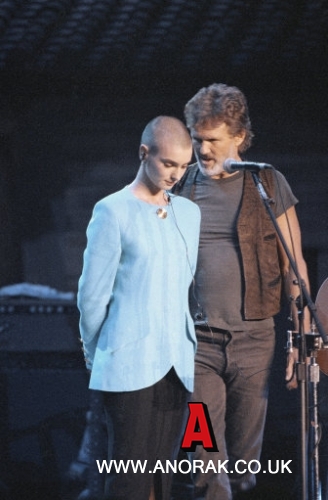

Sister Sinead, Kris Kristofferson (2009)

“I’m singing this song for my sister Sinead

Concerning the god-awful mess that she made

When she told them her truth just as hard as she could

Her message profoundly was misunderstood

There’s humans entrusted with guarding our gold

And humans in charge of the saving of souls

And humans responded all over the world

Condemning that bald-headed brave little girl

And maybe she’s crazy and maybe she ain’t

But so was Picasso and so were the saints

And she’s never been partial to shackles or chains

She’s too old for breaking and too young to tame

It’s askin’ for trouble to stick out your neck

In terms of a target a big silhouette

But some candles flicker and some candles fade

And some burn as true as my sister Sinead

And maybe she’s crazy and maybe she ain’t

But so was Picasso and so were the saints

And she’s never been partial to shackles or chains

She’s too old for breaking and too young to tame.”


Shite Sandwiches

“There is no love in your family.” The Turkish-born psychiatrist summarized my lived experience in a single sentence. I just didn’t know it yet.

It was both earth-shaking and yet felt a little nefarious. “No love?” I wondered wordlessly. “In MY family?” “Is that really what he said?”

I hashed that one line over and over in my head for years.

When the psychiatrist said that simple, explosive line during our biweekly session, I honestly had no idea what he meant. “No love?” “In MY family?” “But, but?” It somehow felt like someone pouring ice-cold mineral oil down my spine through the back of my shirt. I wasn’t sure what I was really feeling but I knew the feeling was foreign and confusing and cold. Ice cold.

I once saw a woman psychologist on the Canadian West Coast. I remember her well-groomed spotlessly clean white West Highland Terrier. I remember she had a long, beautiful green leather couch in her drawing room. I was envious of her beautiful living room and dapper dog.

She listened to my story with keen attention. I trotted out the “no love in my family” story. “A Turkish psychiatrist I once saw,” I told her, “said there was no love in my family. No love? Imagine that? My parents and siblings tell each other we love each other all the time!”

I was slightly frustrated and reluctant to let go of the fantasy that mine had been a happy, wonderful childhood. That I came away from it hurt and confused and beset by dark and difficult feelings was on me. Something was wrong with me. Because they loved me. They told me so all the time.

At one point, the kindly West Coast psychologist looked up from her notebook with reading glasses perched stereotypically on the end of her nose: “Your confusion is understandable,” she said. “If someone feeds you shit sandwiches all your life and tells you they are feeding you steak, you are bound to be confused.”

First, “No love in my family?” Now this. Shit sandwiches that were supposed to stand in for steak? Psychotherapy was nothing else if not extremely confusing and full of strange utterings.

It took many years to realize what these sage advisors actually meant. With time, their insights eventually touched and deeply impacted me. It was true that my childhood was filled with neglect and abuse – sexual, emotional, and psychological. But no one “wanted” to hurt us, I believed.

Caregivers so utterly wrapped up in their own personal problems who have unresolved trauma holding the reins of their own behaviors and being don’t necessarily realize what harm they are doing. Not to themselves and much less to others.

Parents who are intelligent enough to realize these deficits are bad things for a child want very much to cover them up. Or more likely, they are inclined to act as if they are not important. “That’s life,” I often heard my mother say. Along with, “Hand me that bottle of pills from beside my bed, will you sweetie?”

At other times, her head hung limply into the toilet bowl, Mom would retch thick black-green liquid that smelled terrible. She would quickly cover: “It’s only bile, dear. I’m throwing up bile because there’s nothing else in my stomach.” If there was medical import in that statement, it was lost on me as a ten-year-old.

Seeing my mother’s head in the toilet and knowing she was “sick” again was familiar and made more sense. Fluffernutters for supper again tonight.

Dad

Dad once tried to help me visualize how he’d started out in life. “Most guys start out up here,” he pointed at an invisible line high in the air. “I started down here.” His other hand was way, way down very near the table we were sitting at to have lunch.

There’s no question Dad had it rough as a child. His mother – my grandmother – was a monster from all reports. I never knew the woman. She died when I was four and a half months old. But her legacy and impact pervaded my father’s psyche until the day he died. By her emotional bequest to my Dad, she deeply affected mine. Such is the way of inter-generational trauma.

I heard no stories of motherly love and comfort about my father’s mother. Only horror stories. When Dad was about eight years old, he was playing with matches in the back shed near a kerosene barrel. The kerosene ignited. Dad’s whole face was instantly burned. His mother heard his screams and came running into the shed. When she saw what happened, she slapped his face. His skin came away in her hand.

That story was all the insight you needed into his desperately unhappy childhood. He would later explain that in the aftermath of her slap to his savaged face: “She stayed up all night and put egg whites on it.” Like many abused children, Dad remained loyal to his mother until the day he died. By loyal, I mean attached psychologically. He kept her picture by his bed. That is a space usually reserved for precious loved ones.

I have often thought of Dad’s analogy about the different altitudes at which we start out in life. In my head, I picture life’s journey as ascending a mountain. At the top of the mountain, there is a desirable destination – maybe heaven – that people work their whole lives to get to. On top of that mountain, there is a lush green and vast plateau where life is safe and easy, and enjoyable.

To get there, many people seem to take a fairly easy path on a seemingly pre-ordained trajectory. For them, this is the course of their lives. They take a meandering route up the side of the mountain, attending to necessary daily tasks and enjoying life’s pleasantries. They may struggle now and then along the way, but they get help. There is plenty to eat and drink. These pilgrims are kind to one another. Reaching that destination is their expected reward for a path well-walked and a life well-lived.

But there is another side to this mountain. There is no well-mapped path to follow. They face a rocky cliff face. The way is not marked. The route to the top is full of obstacles and danger. Provisions are scarce. Kindness even less so. Their eventual arrival at that vast plain has come at a considerable cost.

This is a route many abused children are forced to take. They climb uncertainly from one rock to the next in life praying the rock they pick will hold.

I have heard the incredulity of other people who were raised by “good enough” parents. They honestly cannot relate to abuse scenarios they cannot ever even imagine happening. They are lucky.

Dad’s difficulties were compounded by the era in which he was born. There were no psychiatrists or psychologists anywhere near him. There were few paths to healing. Self-care was a luxury that was subsumed by life’s difficult demands. In many cases, therapy was scoffed at. Or viewed with deep suspicions.

Dad tried. I remember the endless Dale Carnegie meetings he would attend. He attended men’s weekend spiritual retreats. He tried AA to beat his alcohol addiction. Made it all the way to one year of sobriety once. It didn’t stick. He was drunk as a lord on his 92nd birthday – two months before he died.

My healing journey started while Dad was still on the planet. The healing modalities that are available now were only starting to take hold in society. I told Dad of my interest in exploring the psychological consequences of childhood on our adult lives. He grew quiet on the phone for a minute, and closed the call by saying: “Maybe you can help other peopleby talking about it.” I sure hope so, Dad. RIP